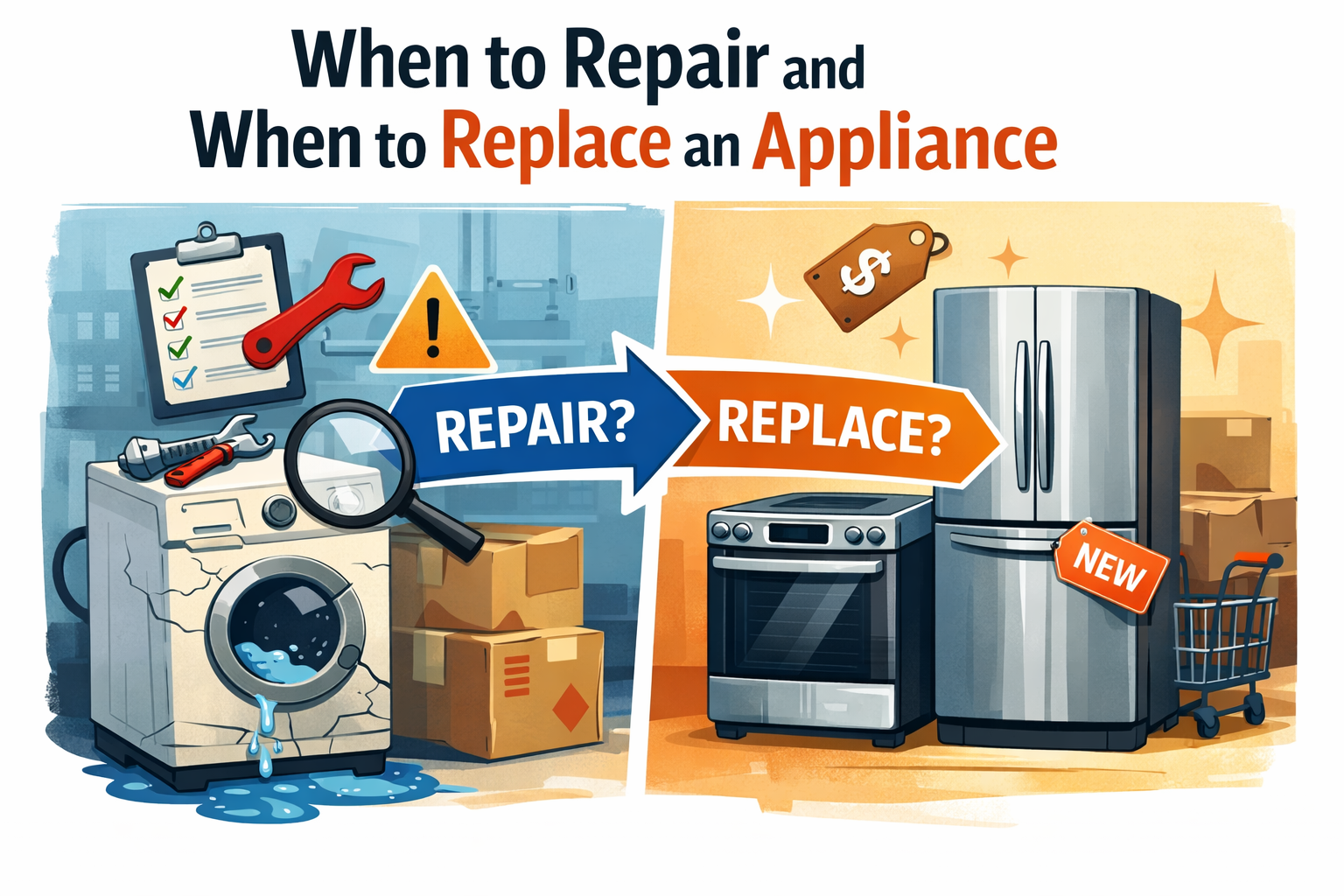
At some point, every appliance reaches that uncertain stage where it’s no longer working quite right, but not completely broken either. That’s usually when the question appears — fix it or move on? With appliance repairs, the answer isn’t always as obvious as it seems at first glance.
It rarely feels clear in the moment
Most decisions don’t happen when something completely stops. They happen earlier, in that grey area where the appliance still works, just differently.
Maybe it’s slower. Louder. Less consistent. You notice it, but it doesn’t force action. So it gets postponed.
This is where hesitation begins. Not because the situation is complicated, but because it’s unclear how serious it really is. And without that clarity, it’s easy to keep using something longer than you probably should.
Cost isn’t the only thing that matters
It’s natural to compare numbers. Repair cost versus replacement cost. That seems logical, almost straightforward.
But the real decision is rarely just financial.
Sometimes a repair fixes the issue completely and the appliance continues working without problems. Other times, it feels more like a temporary solution — something that buys time, but doesn’t fully restore reliability.
People who’ve gone through this a few times tend to notice patterns:
- repeated small issues appearing after a recent fix
- performance that doesn’t fully return to normal
- a growing sense that something else might fail next
None of these guarantee anything. But they shape how confident you feel about keeping the appliance.
A situation that feels familiar to many
Imagine a machine that has already been repaired once. It works again, but not exactly the way it used to. Then, after some time, another issue appears.
At that point, the question changes. It’s no longer just “can this be fixed?” but “does it make sense to keep fixing it?”
This is where appliance repairs start to feel different. Not as a solution, but as part of a longer sequence. Each repair adds context, and that context influences the next decision.
The appliance itself hasn’t changed dramatically. But your relationship with it has.
The shift from fixing to replacing
There’s usually a moment when the decision becomes easier. Not because of a specific rule, but because something feels different.
You stop thinking in terms of immediate solutions and start thinking about stability. Whether the appliance can still be relied on without constant attention.
That shift isn’t always tied to a major failure. Sometimes it comes from a combination of small signs — how often issues appear, how predictable the performance is, how much effort it takes to keep everything running smoothly.
It’s less about one big reason and more about a gradual change in confidence.
Closing thought
Choosing between repair and replacement isn’t about finding a perfect answer. It’s about recognizing when the balance changes. And once you start seeing how appliance repairs fit into that balance, the decision feels less like a dilemma and more like a natural next step.
Leave a Reply