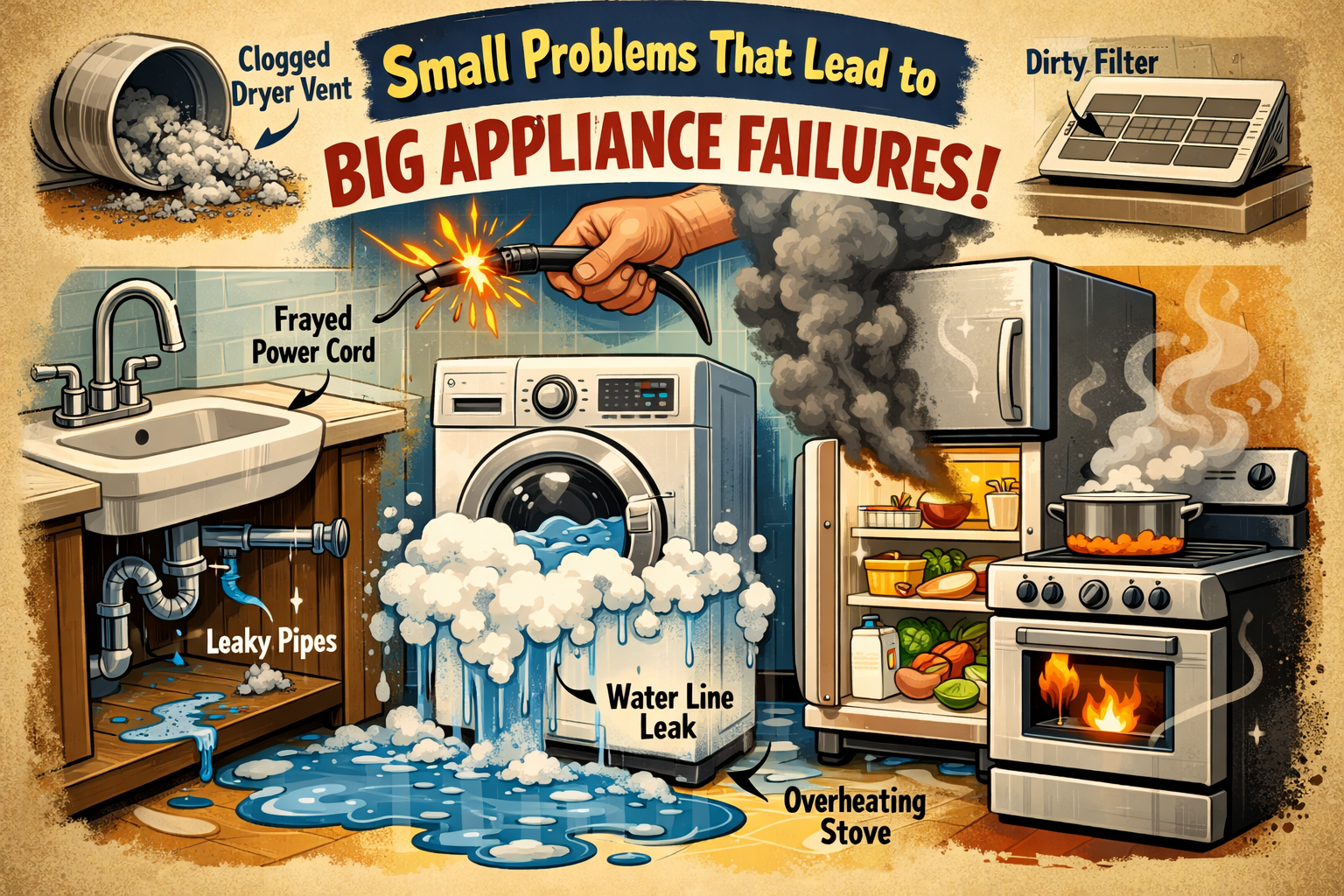
It almost never starts with a breakdown. Most of the time, the first signs are so small they don’t feel worth attention. That’s why appliance repairs often seem sudden, even though the process leading to them has been unfolding quietly for days or even weeks.
It begins with something you barely notice
A different sound. A slightly longer cycle. A door that doesn’t close quite as smoothly. These things don’t interrupt your routine, so they don’t feel important.
And that’s exactly the problem.
When something still works, even imperfectly, it’s easy to adjust to it without thinking. The change becomes part of normal use. You stop noticing it, or you tell yourself it’s nothing serious.
But that small shift is usually the starting point. Not the failure itself — the moment when something inside the appliance stopped working the way it should.
Small resistance builds into real strain
Inside any appliance, parts are constantly moving, heating, cooling, or pushing against something. When everything is balanced, that process feels invisible.
But once resistance appears — even slightly — the system begins to compensate.
A motor works harder. A cycle runs longer. Heat builds up where it shouldn’t. None of this causes an immediate failure, but it changes how the appliance operates over time.
Certain patterns show up again and again:
- airflow becomes restricted, forcing components to overwork
- moving parts lose smoothness and create extra friction
- minor leaks or gaps lead to gradual internal stress
Each of these on its own seems manageable. Together, they create conditions where failure becomes much more likely.
The moment people usually wait too long
There’s a stage where the issue is still small enough to handle easily. The appliance works, just not quite the same way. That difference is noticeable, but not urgent.
So it gets delayed.
A common situation: you notice something unusual once, maybe twice, and then move on. Life continues, the appliance keeps running, and the thought fades away. By the time it returns, the problem has already grown.
This is where many appliance repairs become more complicated than they needed to be — not because the issue was severe at the start, but because it was allowed to develop.
Why the same problems repeat
What’s interesting is how predictable most failures actually are. Different appliances, different functions, but similar beginnings.
It’s rarely about a single broken part. More often, it’s a chain of small changes that weren’t addressed early enough. Each one adds a bit of pressure, until something finally gives.
After experiencing this once or twice, people start to notice patterns. Not in a technical way, but intuitively. A sound that doesn’t feel right. A delay that wasn’t there before.
That awareness doesn’t prevent every issue. But it changes when and how problems are noticed — and that makes a difference.
Closing thought
Big failures don’t appear out of nowhere. They grow from small, almost invisible changes that are easy to overlook. And once you start recognizing those early signs, dealing with appliance repairs becomes less about reacting to breakdowns and more about catching the moment when something first begins to shift.
Leave a Reply